Our team was working on Enterprise AI for few months, and the most useful lesson did not come from a benchmark, a demo, or a model release note.
It came from the moment we tried to put AI into the daily workflow of a real organization.
At the beginning, the discussion was still close to the public AI narrative. Which model is more capable? How fast can it generate? How autonomous can the agent be? How much human work can it replace?
Those questions were not wrong. They were just incomplete.
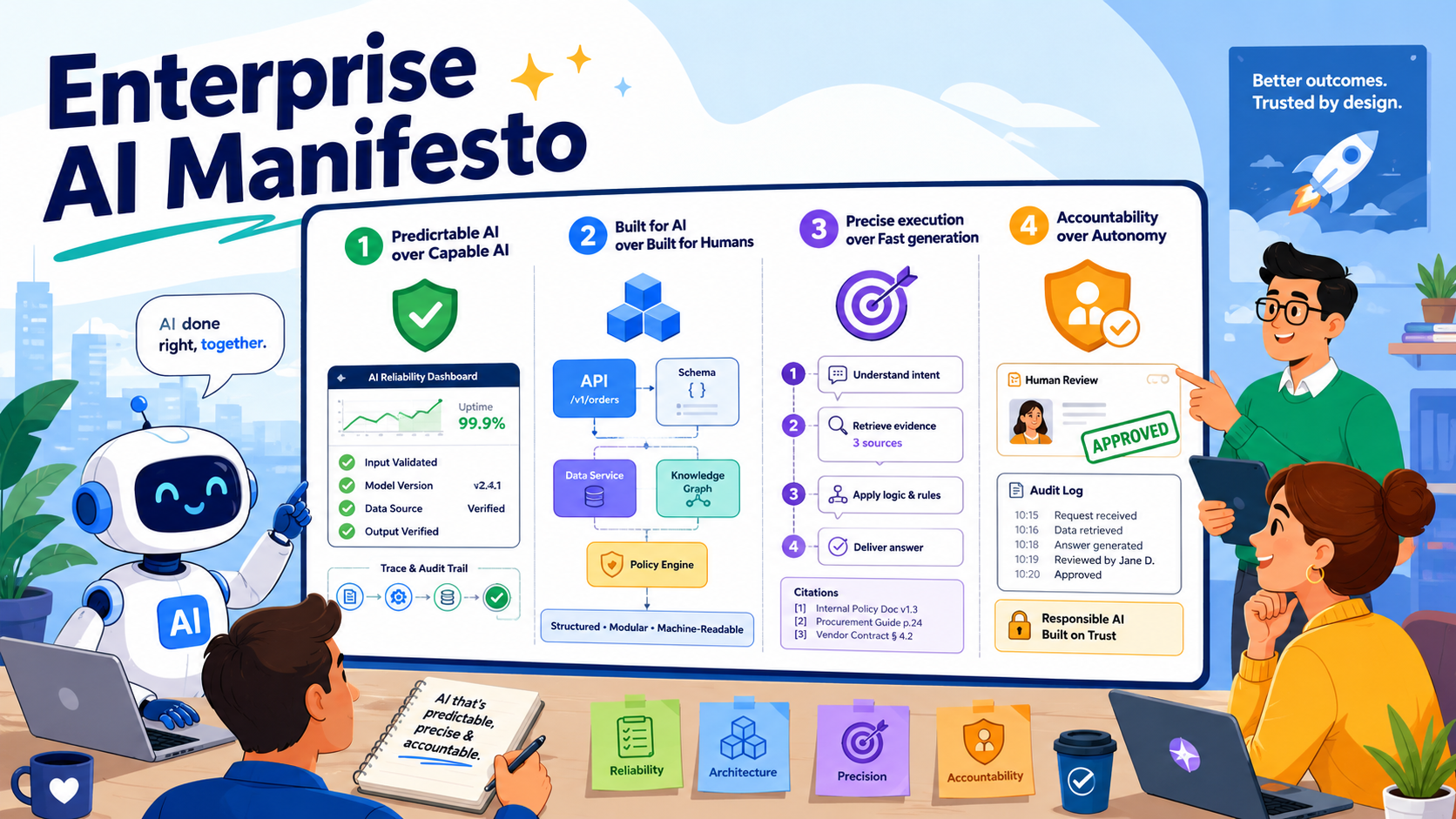
Once we connected AI with enterprise systems, the shape of the problem changed. A good answer was not enough. The answer had to be traceable. A fast draft was not enough. The draft had to follow the real process. A powerful agent was not enough. The agent had to know what it was allowed to read, what it was allowed to write, and who would be responsible when the output affected a decision.
So after a few months of adoption work, I started to write down the principles we were actually using. It became a small manifesto.
Enterprise AI Manifesto
We are uncovering better ways of adopting AI in Enterprise by doing it and helping others do it.
Through this work we have come to value:
- Predictable AI over Capable AI
- Built for AI over Built for Humans
- Precise execution over Fast generation
- Accountability over Autonomy
That is, while there is value in the items on the right, we value the items on the left more.
Predictable AI over Capable AI
Capability is attractive. It is easy to show, easy to compare, and easy to sell.
But in enterprise work, capability without predictability becomes expensive very quickly.
If an AI workflow gives different structures every time, skips evidence, changes its judgment style, or silently chooses different tools, people cannot build a process around it. The system may look smart in a demo, but it becomes hard to operate in production.
For us, predictable AI means the platform can explain what it is doing:
- what input it used,
- what task it is running,
- what tool it called,
- what evidence supports the answer,
- where confidence is low,
- and where human review is still needed.
The point is not to make AI small. The point is to make it dependable enough that teams can use it repeatedly.
Built for AI over Built for Humans
Many enterprise systems were built for human operation. They have pages, forms, dashboards, filters, and buttons. Humans can tolerate that because we can visually scan, infer missing context, and recover from messy flows.
AI does not work well that way.
If we only expose human-facing screens to AI, the system becomes fragile. The model has to read UI text, guess intent, click through layout changes, and reconstruct business meaning from fragments.
We learned that enterprise AI needs systems built for AI access:
- structured APIs instead of screen scraping,
- explicit schemas instead of loose text,
- stable identifiers instead of display names,
- context packages instead of scattered pages,
- tool contracts instead of informal instructions,
- policy checks instead of manual reminders.
This does not mean the system is no longer built for humans. It means the enterprise platform needs a second interface: one that lets AI work with the same business objects in a precise and governed way.
Precise execution over Fast generation
Fast generation is useful when the cost of being wrong is low. It is less useful when the output enters a release decision, a requirement impact analysis, a defect triage, or a customer-facing workflow.
In those cases, speed is not the first bottleneck. Ambiguity is.
The AI must know which version it is analyzing, which requirement changed, which source of truth is authoritative, which evidence is missing, and what output format the next system expects.
Precise execution means we care about the full path, not only the final paragraph:
- resolve the entity correctly,
- retrieve the right evidence,
- follow the workflow steps,
- preserve citations,
- generate structured output,
- stop before unsafe write actions,
- and ask for review when the decision needs a person.
This usually makes the first version slower than a pure chat experience. But it also makes the result usable. In enterprise work, a slower answer that can be trusted beats a fast answer that creates follow-up cleanup.
Accountability over Autonomy
Autonomy is the most tempting word in AI product design. It suggests that the system can take over a whole process and reduce human effort to almost zero.
In real enterprise environments, full autonomy is rarely the first useful step.
The harder question is accountability. If an AI agent changes a Jira ticket, approves a release note, sends a message, or updates a requirement, who owns that action? Who can audit it? Who can explain why it happened? Who can reverse it if it was wrong?
That is why we put accountability before autonomy.
For us, accountability means:
- every run has an owner,
- every tool call is logged,
- every generated conclusion keeps its evidence,
- every write action has a policy decision,
- sensitive actions go through review,
- and AI output remains distinguishable from human approval.
Autonomy still has value. But it should grow from a foundation of accountability, not replace it.
What still hurts
This manifesto is not a finished architecture. It is a record of what became important after the first few months of real adoption.
Some parts are still hard. Predictability can make the workflow feel rigid. AI-native interfaces require backend investment. Precise execution needs better context engineering than most teams already have. Accountability adds friction, especially when people only want a quick answer.
But the direction feels right.
Enterprise AI is not just consumer AI with a login page. It needs different defaults. It needs to respect process, evidence, permission, and ownership from the beginning.
That is the work we are still doing.